

a harmful
history
Some of the most important advances in women's healthcare
came at an unimaginable human cost.
We don't talk about that nearly enough.
We can't understand the healthcare system we inherited
without understanding how it was built.
Because we can't move healthcare forward without first looking backward.
Where It Started
In the 1800s, gynecology began to emerge as its own field of medicine.
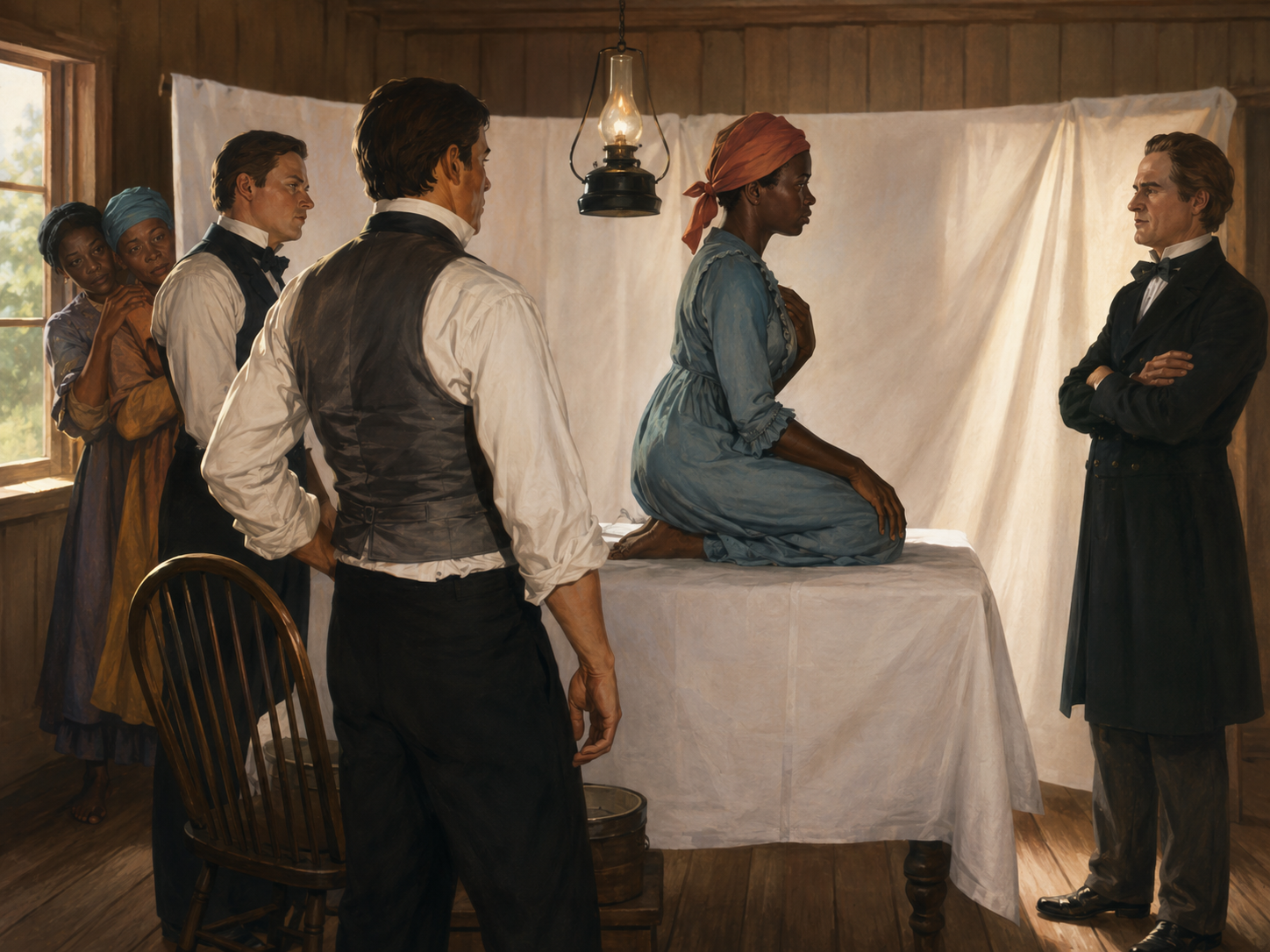
At the center of that history is J. Marion Sims, often called the “father of modern gynecology.” He developed surgical techniques to treat complications from childbirth that are still used today. But those techniques were not developed in an ethical or patient-centered system. They were built through repeated experimental surgeries on enslaved Black women, including a young woman named Anarcha.
Anarcha had endured a prolonged labor lasting days. The baby did not survive, and she was left with a devastating injury called a vesicovaginal fistula, where openings form between the vagina and bladder or rectum, causing constant leakage of urine and stool. At the time, this condition often led to isolation and social exclusion. Sims became determined to “cure” it, and over the course of several years, he performed repeated surgeries on Anarcha and other enslaved Black women—operating on her approximately 30 times before claiming success.
These procedures were performed without anesthesia, even after anesthesia had begun to emerge in medical practice. Many of his early attempts failed, leading to infection and prolonged suffering. And while these women were subjected to repeated operations, Sims later went on to build his reputation, found a hospital for women, and rise to national prominence in medicine.
These women were not patients in the way we define patients now. They were not in a position to consent, refuse, or shape their care. They were treated as a means to an outcome. And that foundation didn’t just shape the procedures that came out of this era. It shaped what the field learned to prioritize, and what it learned to overlook.
At the same time, this wasn’t a moment where reproductive care was being created from nothing. Long before gynecology became a formal medical specialty, care around pregnancy, birth, and reproductive health already existed within communities. It was led by midwives, doulas, and community healers, many of whom were Black women and Indigenous women carrying generations of knowledge. In many communities, especially in the American South, Black midwives were the primary providers of childbirth care well into the early 20th century.
This care was relational. It was continuous. It was built on knowing the person, not just the pregnancy. It drew on observation, lived experience, and generational knowledge that had been passed down, refined, and trusted within communities.
But as medicine began to professionalize in the 19th century, it didn’t simply expand on these systems. It replaced them. Physician-led care, largely dominated by white men, positioned itself as the authoritative form of knowledge, while community-based care was increasingly pushed aside. Midwives, particularly Black midwives, were discredited, restricted through licensing laws, and labeled as unsafe or untrained, despite their longstanding role in providing care.
This shift wasn’t just about safety or scientific advancement. It was also about control. Control over whose knowledge counted, who was allowed to provide care, and what kind of care was considered legitimate.
As that transition happened, reproductive healthcare moved out of homes and communities and into institutions. The relationship between patient and provider became more distant. Listening became less central. And patients became more passive in their own care, expected to trust a system that no longer knew them in the same way.
When you look at modern gynecology through this lens, the gaps we see today start to make more sense. The system didn’t just evolve. It was built by replacing community-based, relationship-centered care with a model that prioritized authority and control, while also advancing through the use of marginalized bodies without consent.
What That Foundation Created
The system didn’t just carry forward surgical techniques. It carried forward priorities.
When a field is built in a way that doesn’t require listening, doesn’t center consent, and doesn’t treat pain as urgent, those gaps don’t disappear over time. They become part of how care is delivered.
And you can still see that today.
Across the board, people describe leaving medical visits feeling unheard. Symptoms that don’t fit a clear pattern are dismissed or delayed. Pain is normalized instead of investigated. Conversations feel rushed, incomplete, or one-sided. These experiences are often explained away as individual moments—a bad visit, a miscommunication, a provider who “just wasn’t a good fit.” But when the same patterns show up across different providers, different systems, and different parts of the country, it becomes clear that this isn’t random. It’s structural.
You can see the impact of that structure in our outcomes. The United States has one of the highest maternal mortality rates among developed nations. That alone tells us something isn’t working the way it should.
But the story doesn’t stop there.
Because within that already high rate, Black women are three to four times more likely to die from pregnancy-related causes than white women. And that disparity holds true across income levels, education levels, and access to care.
So yes, this system is failing women broadly. But it is failing Black women more, and more dangerously.
That difference isn’t explained by biology. It’s explained by how care is delivered, how concerns are responded to, and whose pain is taken seriously in the moments that matter.
The same structural gaps that affect everyone—short visits, delayed diagnoses, a lack of listening—become amplified when layered with bias. When there is less trust in what a patient is reporting, when symptoms are more likely to be minimized, when urgency is not applied equally, outcomes change.
And in reproductive healthcare, where timing can determine everything, those differences are not small.
The modern healthcare system is built for efficiency. Short visits. Clear diagnoses. Fast decisions. That works well for problems that are easy to measure and quick to solve. But reproductive health doesn’t always work that way.
Pain can be complex. Symptoms can take time to explain. Experiences are shaped by identity, history, and trust. And when a system isn’t designed to hold that complexity—or to examine the bias within it—it doesn’t just miss things.
It misses them in ways that follow the same lines of inequality that have always existed.
What It Feels Like Inside the System
The gaps in healthcare don’t usually start at the moment something goes wrong.
They start earlier—at the level of being heard, believed, and taken seriously.
Across the board, patients describe similar experiences. They bring up symptoms and leave feeling like they weren’t fully addressed. They try to explain pain that doesn’t fit a clear pattern and are told it’s normal. They ask questions and walk away without a clear plan. Visits feel rushed. Conversations feel incomplete. There’s often a sense of having to push just a little harder to be understood.
These moments are easy to dismiss on their own. A busy day. A miscommunication. A provider who just didn’t quite get it right. But when the same experiences happen again and again, across different providers and different systems, they start to form a pattern. And that pattern has real consequences.
The United States has one of the highest maternal mortality rates among developed nations. Complications during pregnancy, delayed diagnoses, and missed warning signs are not rare experiences. They are part of a system that is not consistently set up to catch complexity early or respond to it quickly.
Part of that comes down to how care is structured. Visits are short. Systems prioritize efficiency. Providers are often expected to move quickly from one patient to the next. That works for straightforward concerns, but reproductive health is often anything but straightforward.
Pain can be difficult to describe. Symptoms can take time to connect. Experiences are shaped by history, identity, and trust. And when there isn’t enough time or space to fully explore those layers, things get missed.
Most of the time, those misses are not intentional. They are the result of a system that wasn’t built to slow down, to listen deeply, or to hold complexity.
But even when something isn’t intentional, it can still be harmful.
And while many patients experience these gaps, they are not experienced equally.
For some, these moments lead to frustration. For others, they lead to delayed care, worsening conditions, or missed opportunities for early intervention. And understanding that difference matters.
Because it shows us that this isn’t just about individual experiences. It’s about a system that creates patterns—and those patterns shape outcomes.
If you’re trying to make sense of those patterns in your own care—
what’s normal, what’s not, what to ask, and how to advocate for yourself—
you can find more on the Your Questions, Answered page.
And if you’d like to learn more about who is most affected by these gaps—and how?
Check out Accessing Reproductive Healthcare as a Black Woman

“The gaps in care aren’t random.
They follow the same lines of inequality
that have always existed.”
-Nikki Sapiro Vinckier
We Deserve More: How Reproductive Healthcare is Broken and What You Can Do About It